# Pan-African Parliament/ AGP

## Pan-African Parliament

### Recommendations and Resolutions

#### Preamble and Preface&#x20;

In PAP documents, we use `PREAMBLE` for text like \
"*The Pan-African Parliament,*\
*Recalling X,*\
*Noting of Y, etc."*

We haven't yet found a use for `PREFACE`.

#### Body&#x20;

The `BODY` in Recommendations usually begins as is highlighted in the example below.

![](/files/WG5eutl6TnytouqSNdNY)

The `BODY` in Resolutions usually begins as is highlighted in the example below.

![](/files/bwn1v5FaRWpd069nF9Bz)

Below are other examples of the `BODY` of Recommendations and Resolutions.&#x20;

![](/files/5ACJvKDsyWQR360xI4K1) ![](/files/EnKJHkFU1J66TwiMwxTQ)

#### Documents without a preamble

Sometimes a document will not have a preamble. In such instances, the first keyword used should be `BODY`. Below is an example of one such document.

![](/files/BCDU5gXXq6I5wiOrbKNu)

#### Hierarchical structure

Within the main body and in Schedules, content is often grouped under headings.

In legislation, the most common groupings are Chapters and Parts.&#x20;

For PAP documents, which often don't specify what these headings are called, we use Divisions and Subdivisions.

The most common grouping of content is numbered paragraphs.

#### Keywords most commonly used&#x20;

`DIVISION`

`SUBDIVISION`

`PARA`

`SUBPARA`

### Notes for reviewers

#### Dates

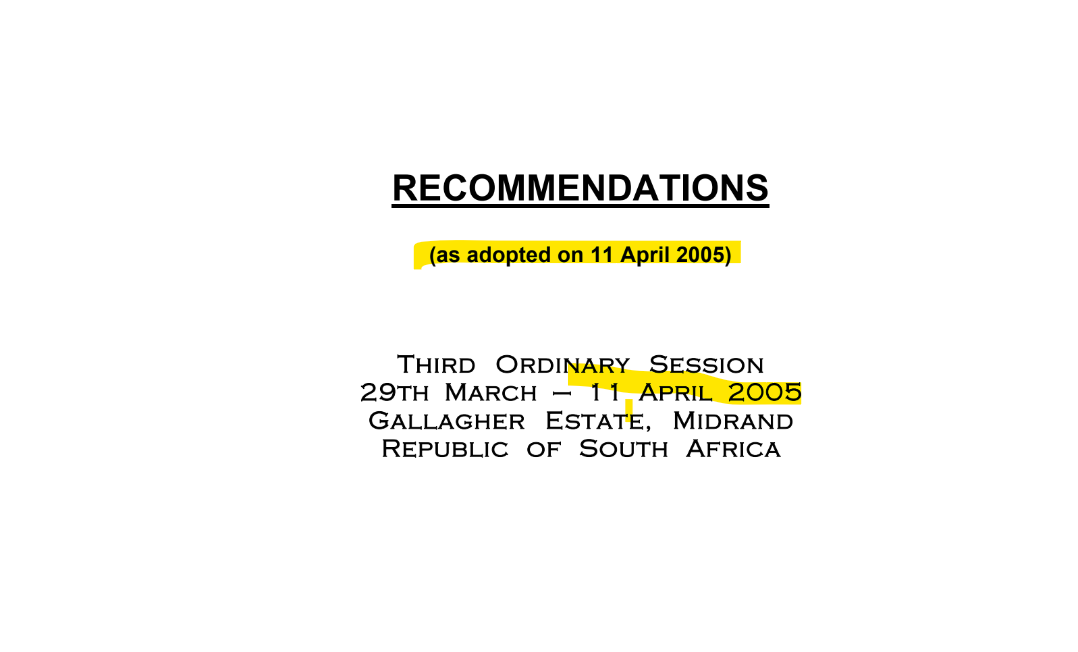
The adoption date of a PAP document (resolution, recommendation or model law) is the last date of the session in which the document was presented.&#x20;

<figure><img src="/files/NFETdZJkw8NC9XnCciJN" alt=""><figcaption><p>e.g. Documents presented at the 3rd session of the Pan-African Parliament in 2005, were all adopted on the 11th of April 2005. </p></figcaption></figure>

## AGP

### General <a href="#general" id="general"></a>

#### Preface and preamble <a href="#preface-and-preamble" id="preface-and-preamble"></a>

In AGP treaty documents, we use `PREAMBLE` for text like "*The African Union, Recalling X, Noting of Y, etc."* We haven't yet found a use for `PREFACE`.

In the Preamble of a document, style the first word of each sentence (words highlighted in the image below) as it is in the source document. If such word it **underlined**, please remove the underlining and **add italics** to it.&#x20;

![](/files/2D7rWGxce1QKOmH4KGIT)

#### Body <a href="#body" id="body"></a>

The `BODY` in treaties usually begins **after** the phrase "Have agrees as follows", as is highlighted in the example below.![](https://1576826725-files.gitbook.io/~/files/v0/b/gitbook-x-prod.appspot.com/o/spaces%2F-LoitfV0OP-HrMLMazq_%2Fuploads%2FMaItnlGMIaUGf46n7Bfc%2Fimage.png?alt=media\&token=b24a6f96-cc48-4bec-b29d-7894883ee60d)

#### Documents without a preamble <a href="#documents-without-a-preamble" id="documents-without-a-preamble"></a>

Sometimes a document will not have a preamble. In such instances, the first keyword used should be `BODY`.

#### Hierarchical structure <a href="#hierarchical-structure" id="hierarchical-structure"></a>

Within the main body and in Schedules, content is often grouped under headings. The most common groupings are Chapters and Parts. For groupings not specified as either a Parts, Chapters or other keyword, we use Divisions and Subdivisions. The most common grouping of content is numbered articles or paragraphs .

#### Keywords most commonly used <a href="#keywords-most-commonly-used" id="keywords-most-commonly-used"></a>

`CHAPTER/ PART`

`ARTICLE`

`PARA`

`SUBPARA`

If a document is divided by headings for which a keyword exists, such as `CHAPTER/PART`, please use `SUBPART`  for any further headings which do not have a keyword.

If a document is divided by headings for which a keyword does  not exist, please use `DIVISION`  and `SUBDIVISION`  for those headings.

#### Things to look out for

**Please** change that appears at the end of a document to sentence case as demonstrated in the example below:

**ADOPTED BY THE TWENTY-THIRD ORDINARY SESSION OF THE ASSEMBLY, HELD IN MALABO, EQUATORIAL GUINEA  27TH JUNE 2014** changes to **:**&#x20;

**Adopted by the twenty-third Ordinary Session of the Assembly, held in Malabo, Equatorial Guinea 27th June 2014**&#x20;

**Please** take out underling in headings

![Please take out underling in headings.](/files/x8OJBsfudNZqpcwPY6Q5)

**Please** fix spacing errors. Please add a comment in the margin ONLY if adding a space changes the meaning of the sentence.

![Examples of spacing issues](/files/sw18h3SAYxOtoLbXJmtC)

**Please** remove signatures that appear at the end of documents.

![](/files/nzGdzJslfWJvPNol2IMF)

#### &#x20;


---

# Agent Instructions: Querying This Documentation

If you need additional information that is not directly available in this page, you can query the documentation dynamically by asking a question.

Perform an HTTP GET request on the current page URL with the `ask` query parameter:

```
GET https://docs.laws.africa/style-guides/pan-african-parliament-agp.md?ask=<question>
```

The question should be specific, self-contained, and written in natural language.
The response will contain a direct answer to the question and relevant excerpts and sources from the documentation.

Use this mechanism when the answer is not explicitly present in the current page, you need clarification or additional context, or you want to retrieve related documentation sections.
